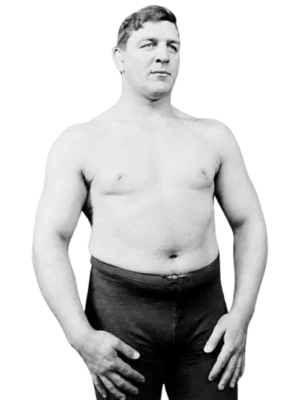
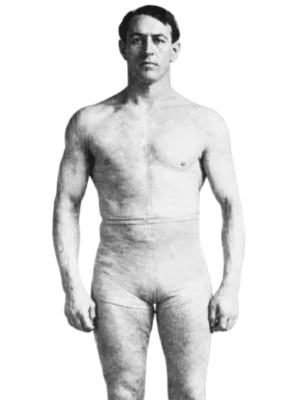
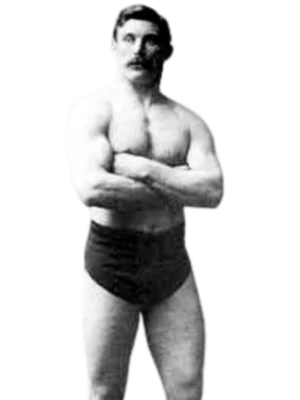
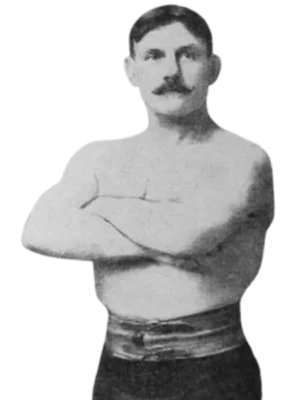
The Carnival Era in professional wrestling covers the late 1800s and early 1900s. It represents the earliest origins of what would later become the modern wrestling industry. This period emerged from the traveling carnival culture that spread across America after the Civil War. It was during this time that professional wrestling developed its core identity, including its business practices, insider language, and blend of real athleticism and staged performance.
In the decades after the Civil War, traveling carnivals moved from town to town across the American countryside. They were one of the main forms of entertainment in a time before radio or television existed. Wrestling quickly became one of the most profitable attractions these carnivals had to offer through what were known as athletic shows.
In these shows, experienced wrestlers, many with amateur wrestling backgrounds, would challenge anyone in the audience to step into the ring. If a local could beat the carnival’s champion within a set time limit (usually fifteen minutes), they would win a cash prize.
But the game was rigged from the start. Carnival operators planted secret helpers in the crowd who would accept the challenge and beat the wrestler on purpose. This made it look like the champion could be taken down, which drew in local tough guys willing to pay a fee and test their strength.
Once a real challenger stepped up, the carnival wrestler would make quick work of them. Meanwhile, the planted helpers would place side bets with the crowd, squeezing out even more money on top of the entry fee.
This entire system was built around tricking paying customers, and it is where professional wrestling first picked up the idea of the mark. A mark was any ticket buyer or spectator who believed what they were seeing was real and could be taken advantage of for profit.
Making this system work required several different types of people. Promoters and managers were the ones pulling the strings behind the scenes, creating characters and storylines to build excitement and draw crowds. The carnival wrestlers themselves traveled with the shows, sharpening their skills through nightly challenges and the constant need to protect both their reputations and the show’s income.
Then there were the barnstormers, or freelance competitors, who traveled from town to town on their own, taking on open challenges. Barnstormers would also sometimes team up with carnival wrestlers to stage matches for gambling profits. These roles often overlapped, with people moving between them as opportunities came and went, but together they formed the system from which modern professional wrestling grew.
The wrestling style of this period was built on catch-as-catch-can wrestling, a grappling style that started in Lancashire, England, and was reshaped through the American carnival circuit. Over time, some carnival wrestlers developed dangerous submission moves known as hooks, techniques designed to end fights quickly by breaking bones or tearing tendons.
A wrestler who was skilled in these techniques was called a hooker, someone who could force a real submission within seconds if a match ever went off-script. That said, true hookers were only a small number of carnival wrestlers. Many performers relied more on time limits, rough tactics, and cooperation with challengers to control how a match ended.
Still, the hooker’s reputation carried a lot of weight. It served as an insurance policy that kept the business running smoothly and discouraged challengers from getting out of hand.
Many of professional wrestling’s most lasting terms are commonly traced back to this carnival culture. The word kayfabe, the code of secrecy around the staged nature of wrestling, is often believed to have come from carnival worker slang, though its exact origin is still debated. Some theories connect it to the Pig Latin version of “be fake,” while others link it to different phrases from carnival language.
Other terms like work (a staged match or storyline), shoot (a real, unscripted contest), and mark (an outsider who believes the act is real) are also frequently tied to the carnivals’ need to talk about business using coded words that spectators could not understand. The precise origins of each term are hard to confirm with certainty.
Two of the most well-known figures to come out of the Carnival Era were Martin “Farmer” Burns and his student Frank Gotch. Burns reportedly competed in over 6,000 matches and lost only seven, despite weighing just 165 pounds.
He was one of the most skilled grapplers of his generation, but his biggest impact came through his work as a trainer. He produced a line of top-level wrestlers who would go on to shape the business for decades.
Gotch, who trained under Burns, became one of the first true mainstream sports superstars in America. His World Heavyweight Championship reign from 1908 to 1913 came during wrestling’s peak popularity in this period, and his two matches against European champion Georg Hackenschmidt are seen as defining moments of the era. The second of those matches reportedly drew around 30,000 fans to Chicago’s Comiskey Park in 1911.
By the middle of the decade, though, wrestling was falling apart. Gotch retired in 1913, and no one stepped up to replace him as the face of the sport. Fans had been questioning whether matches were real for years, and without a big name to keep them invested, those doubts only got louder.
The style itself was also a problem. Most matches were slow, grinding affairs on the mat that casual fans had little interest in sitting through. When World War I pulled the country’s attention in a completely different direction, wrestling found itself pushed to the margins of American entertainment.
The Carnival Era slowly gave way to a more organized style of business in the early 1920s, largely through three men: Ed “Strangler” Lewis, his manager Billy Sandow, and fellow wrestler Joseph “Toots” Mondt. They were later nicknamed the Gold Dust Trio.
Mondt was a product of the carnival circuit himself, discovered and trained by Farmer Burns. He had watched crowds shrink for years as fans grew tired of watching two men grind on the mat for an hour or more with little action. His answer was a new style he called “Slam Bang Western Style Wrestling,” which mixed elements of Greco-Roman wrestling, catch wrestling, boxing, and theatrical performance.
It introduced moves like body slams, suplexes, and punches that gave matches a faster pace and made them more fun to watch. Just as important, Mondt treated the finish of a match as a piece of storytelling, designing endings that would leave fans wanting to come back and see what happened next.
Worked finishes and organized promotions were not new ideas. Wrestlers had been cooperating on match outcomes, and promoters had been fixing results long before the 1920s. What made the Gold Dust Trio different was how they brought all of these pieces together and ran them on a larger scale than anyone had before.
They signed hundreds of wrestlers to long-term contracts, giving performers steady pay instead of the unpredictable night-to-night arrangements that had been common in the carnival days. They moved shows out of small venues and into major sports arenas. They built a booking system that coordinated matches and storylines across cities, laying the foundation for the territorial model that would come later.
Even as the Gold Dust Trio and other promoters reshaped wrestling into a more organized business through the 1920s and 1930s, carnival-style athletic shows continued to operate in smaller towns and rural areas for decades. Wrestlers still traveled with carnivals, still took on local challengers, and still ran the same cons that had defined the business since the 1800s.
But by the late 1940s, the old carnival model had been almost entirely replaced. In 1948, promoters across the country came together to form the National Wrestling Alliance (NWA), creating a unified system of protected regional territories with a single recognized world champion. That moment marked the full arrival of the Territorial Era and the end of the loose, unstructured way wrestling had operated since its carnival beginnings.
The Carnival Era left its fingerprints on every part of modern professional wrestling. Protecting the business through kayfabe, balancing real grappling ability with entertainment, the roles of promoters and bookers, the art of the worked finish, and the relationship between performers and their audience all go back to the traveling carnival midways of the late 1800s and early 1900s.
Wrestling traditions from European catch wrestling, French and British tournament circuits, and other international styles also helped shape what professional wrestling would become, but the American carnival experience remains one of its most important influences.