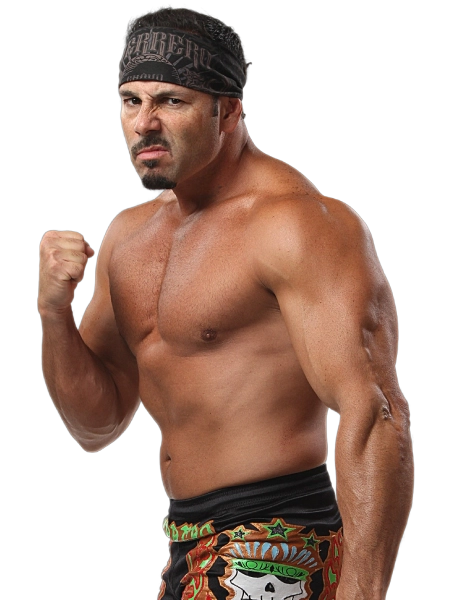
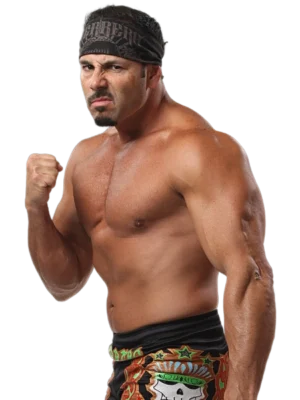
Chavo Guerrero Jr. carries the weight of one of wrestling’s most famous surnames with a mix of pride, a chip-on-his-shoulder attitude, and a sharp sense for character building.
For many fans, he is the slick cruiserweight and tag partner who schemed with Eddie Guerrero in the “Lie, Cheat, and Steal” era, the spiteful rival who punished Rey Mysterio, and the veteran who later reinvented himself as an ECW Champion and worldwide tag specialist.
Outside the ring, he has helped shape modern wrestling on television, working behind the scenes on shows like GLOW and Young Rock, and, more recently, returning to WWE as a producer for AAA.
His path was shaped from the start by family. Born Salvador Guerrero IV in El Paso, Texas, he grew up as the son of Chavo Guerrero Sr. and the nephew of Mando and Eddie Guerrero, which placed him directly inside the Guerrero wrestling dynasty.
Rings, gyms, and road stories formed the backdrop of his childhood. When he decided to wrestle, he didn’t have to look far for teachers.
He trained under his family, learning the timing and rhythm of lucha libre alongside American-style ring psychology, and by May 1994, he had turned that upbringing into a professional debut, working in Mexico and touring Japan, including a run in New Japan Pro-Wrestling’s (NJPW) junior heavyweight scene and an appearance in the 1996 Best of the Super Juniors tournament.
In May 1996, Guerrero signed with World Championship Wrestling (WCW). He immediately stepped into a deep cruiserweight division that featured names like Dean Malenko, Rey Mysterio Jr., and Chris Jericho. His early WCW work showed a young wrestler who could hang technically but was still finding his presence on television.
He wrestled Ric Flair for the WCW United States Championship that summer, then settled into regular Nitro and pay-per-view appearances.
Over time, stories with his uncle Eddie helped define him. Chavo was often portrayed as the earnest relative pushed toward Eddie’s rule-breaking, sometimes resisting and sometimes joining in, and that push-pull gave him memorable segments with props like his toy horse “Pepe.”
In 2000 he took on the Lieutenant Loco persona as part of the Misfits in Action faction and won both the WCW Cruiserweight Championship and the WCW World Tag Team Championship with Corporal Cajun, giving him his first major titles on American TV before WCW shut down in 2001.
When WWE bought WCW in 2001, Guerrero’s contract was one of the deals that carried over, bringing him into the Invasion storyline as a member of The Alliance.
The first year left him mostly in undercard cruiserweight matches, but the turning point came in 2002 when he linked back up with Eddie to form Los Guerreros. On SmackDown, the two became a key part of the famous “SmackDown Six” with Kurt Angle, Chris Benoit, Rey Mysterio, and Edge, who carried the Ruthless Aggression Era.
Their vignettes about lying, cheating, and stealing, paired with slick in-ring work, made them fan favorites even while they cheated to win.
As Los Guerreros, Chavo and Eddie captured the WWE Tag Team Championship twice and helped make the team one of the defining acts of that period.
After their team split, Guerrero moved back into singles action and focused on the cruiserweight division. In February 2004 at No Way Out, he defeated Rey Mysterio for the WWE Cruiserweight Championship with help from his father, Chavo Guerrero Sr.
He then successfully defended the title in a series of television matches and at WrestleMania XX before short title changes that kept him central to that weight class through mid-2004.
The following year, WWE experimented with him as Kerwin White, the controversial golf-obsessed character who rejected his Mexican heritage. However, that story ended in late 2005 after Eddie Guerrero’s sudden death.
Chavo, who discovered his uncle unresponsive in a Minneapolis hotel room, dropped the Kerwin persona, wrestled as himself again, and honored Eddie with tributes like using the Three Amigos suplexes and the Frog Splash against John “Bradshaw” Layfield days after his death.
From 2006 to 2009, he stayed active in WWE, moving between brands and storylines. The biggest run came on the rebooted ECW brand in early 2008, when he targeted CM Punk and, with Edge’s help, defeated Punk in a no-disqualification match to win the ECW Championship.
He later aligned with Edge and Vickie Guerrero in the La Familia group on SmackDown, serving as a supporting heel around Edge’s main-event programs. As the late 2000s wore on, his role shifted toward comedy and midcard matches, and in June 2011, he asked for and received his release from WWE after a decade with the company.
Guerrero then entered a long veteran phase across the world. He wrestled in Puerto Rico’s World Wrestling Council, winning the WWC Caribbean Heavyweight Championship, and took part in TNA’s India project Ring Ka King, where he held the tag titles.
In July 2012, he signed with TNA, teaming with Hernandez. The pair captured the TNA World Tag Team Championship twice and gave the company a reliable, TV-ready babyface team before Guerrero’s departure in 2013.
In 2014, he joined Lucha Underground (LU), both as an in-ring performer and behind-the-scenes presence. On-screen, he worked as a veteran luchador with shifting loyalties, even winning the Gift of the Gods Championship, while off-screen, he helped produce and shape matches.
In later years, he kept a steady presence on the independent circuit and briefly appeared for AEW in 2021 as an on-screen consultant for Andrade El Idolo before focusing more on film and television.
Guerrero served as wrestling coordinator and trainer for Netflix’s GLOW series, then did similar work for NBC’s Young Rock, while also taking acting roles such as portraying The Sheik in the 2023 film The Iron Claw.
In the ring, Guerrero built a wrestling style around his family’s lucha heritage with crisp American TV structure. He favored smooth arm-drags, dropkicks, tilt-a-whirl backbreakers, and sharp counters. But also used high-impact signature moves like the Gory Bomb, the Three Amigos vertical suplex sequence, and the Frog Splash that linked him to Eddie.
As a heel, he often slowed matches down to jaw at the crowd or look for openings to cheat with chairs or low blows, while as a babyface, he wrestled with more urgency and scrappy comebacks. He had versatility that allowed him to move from serious cruiserweight title bouts to comedy segments without losing believability.
By 2025, Guerrero’s career had come full circle. After years of working across promotions and in Hollywood, he announced that he had re-signed with WWE, taking a producer role tied to the company’s involvement with AAA and using his experience to help shape the next generation.
For a wrestler who grew up in one of lucha libre’s most important families, Chavo Guerrero Jr.’s story is now as much about passing on knowledge as it is about the titles and storylines that first put his name in front of the world.






Share Your Thoughts on This Wrestler
You must be logged in to post a comment.