
Championships Won (1)
Career Summary
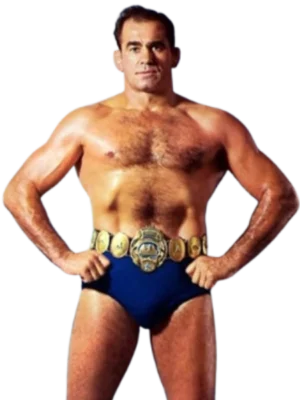
Lou Thesz was one of the most important wrestlers in pro wrestling history and one of the men who helped connect wrestling’s older competitive roots to the world title system that shaped the territory era. He was born on April 24, 1916, in Banat, Michigan, and grew up in St. Louis, where wrestling became part of his life early. His father had wrestled in Europe, so Thesz was exposed to both amateur and professional wrestling from a young age.
He trained under George Tragos and also learned from Ad Santel and Ray Steele, which gave him a strong foundation in catch wrestling. Later, Ed “Strangler” Lewis became an important influence and managed him for a large part of his career.
Thesz turned professional in 1932 at just 16 years old, entering the business when wrestling still had much closer ties to legitimate grappling than it would in later decades. His catch wrestling background shaped the way he worked, with a style built on technique, control, and conditioning that he carried throughout his career.
A major early step in his rise came on December 29, 1937, when he defeated Everett Marshall in St. Louis to win the National Wrestling Association World Heavyweight Championship at just 21 years old. He lost that version of the title to Steve “Crusher” Casey in early 1938, but later regained recognized world title status by defeating Marshall again in 1939 and then Bill Longson in 1948.
By that point, Thesz had built a reputation as a wrestler promoters could trust with an important championship. He could work long matches, carry himself like a champion, and make the title feel important from one territory to the next.
His role in wrestling history became even more important after the National Wrestling Alliance (NWA) formed in 1948. The NWA was created so member territories could rally around one recognized traveling world champion. Orville Brown was first recognized as NWA World Heavyweight Champion, but a car accident ended his career before a planned unification match with Thesz could happen, and Thesz was awarded the title.
Across three reigns, he held the NWA World Heavyweight Championship for a combined 3,749 days, longer than any other champion in that title’s history. Promoters trusted him with the belt not just because he looked the part, but because his catch wrestling background made him hard to take advantage of in an era when that still mattered.
One of the most discussed disputed moments of his career came in 1957, when he suffered a back injury in a match with Édouard Carpentier. Carpentier won the match, but the NWA didn’t recognize a title change and continued to recognize Thesz as champion, while some markets recognized Carpentier separately.
Thesz eventually dropped the belt to Dick Hutton and stepped away, then came out of semi-retirement in 1963 to defeat Buddy Rogers and win another world championship at age 46.
Thesz also became an important figure outside the United States, especially in Japan. His matches with Rikidozan were treated as major events during the early growth of Japanese pro wrestling and became part of an important period in the sport’s development there.
He later became the first holder of the NWA International Heavyweight Championship, a title that is now part of AJPW’s Triple Crown lineage. In 1976, he was also recognized as the first UWA World Heavyweight Champion after a draw with Mil Máscaras. Those accomplishments showed that promoters in different countries still saw him as a title-level figure long after his main NWA title years had passed.
His influence also carried over into the moves and techniques that remained part of wrestling after his peak years. He is associated with the Lou Thesz Press, the STF, the powerbomb, and the belly-to-back suplex that later became better known as the German suplex.
Even late in life, he was still stepping into the ring. His final public match took place on December 26, 1990, when he wrestled Masahiro Chono for New Japan Pro Wrestling (NJPW) at age 74.
In his later years, Thesz stayed involved in wrestling as a trainer, commentator, and respected veteran. He founded the Virginia Wrestling Academy in 1988, served as president of the Cauliflower Alley Club from 1992 to 2000, and wrote the autobiography “Hooker”. He died on April 28, 2002, following complications from triple bypass surgery.
The respect Thesz earned across wrestling can be seen in the honors attached to his name. He was the first inductee into the WCW Hall of Fame in 1993, part of the inaugural class of the George Tragos and Lou Thesz Professional Wrestling Hall of Fame in 1999, inducted into the NWA Hall of Fame in 2005, and recognized by WWE as a Hall of Fame Legacy inductee in 2016.
Titles Held
| Belt | Won | Opponent(s) | Partner(s) | Event | Days Held |
|---|---|---|---|---|---|
| Nov 27, 1949 | Lou Thesz was recognized as NWA World Heavyweight Champion after Orville Brown was unable to continue as champion due to the severe injuries he suffered in a car accident on November 1, 1949. With Brown forced out and a scheduled unification defense no longer possible, the NWA shifted the championship to Thesz, beginning his long first reign as the NWA’s traveling world champion. | N/A | 1941 |
Matches
No matches recorded for this wrestler yet.




Share Your Thoughts on This Wrestler
You must be logged in to post a comment.