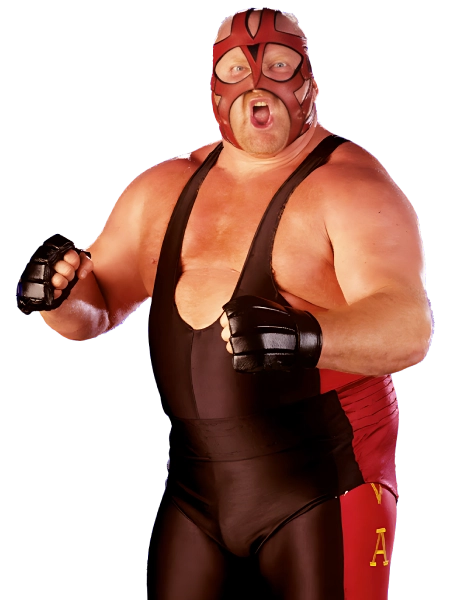
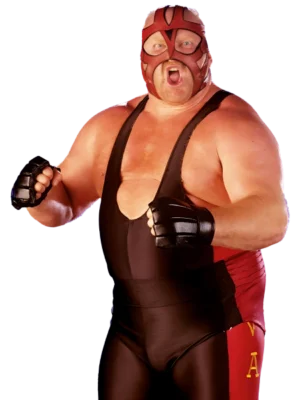
Vader (Leon White) burst onto the wrestling scene with force. He entered the ring in black and red gear, wearing a horned mastodon helmet that made him look more like a machine than a man. Then the bell rang, and the surprise followed.
He delivered powerful strikes, charged into corners, and even jumped for moves that seemed impossible for someone his size. In the late 1980s and 1990s, that combination turned him into one of the defining super heavyweights of his era.
He became a three-time WCW World Heavyweight Champion, a headline name in Japan, and later challenged Shawn Michaels for the WWF Championship in a major SummerSlam main event.
Before wrestling, White was known for his athletic skills in football. He grew up in Southern California, played offensive line at the University of Colorado, and was drafted by the Los Angeles Rams. After a serious knee injury ended his NFL career, he turned his focus to professional wrestling.
He started wrestling after training with Brad Rheingans and made his pro wrestling debut in 1985 in the American Wrestling Association (AWA). From 1985 to 1987, he wrestled as Baby Bull and later Bull Power, learning to use his size without losing agility. At the same time, he toured Europe for Otto Wanz’s Catch Wrestling Association (CWA), where he adjusted to fans who preferred a tougher, more physical style.
In 1987, his career changed when he joined New Japan Pro Wrestling (NJPW) as Big Van Vader. The mask, helmet, and the image of an unstoppable outsider gave him a strong new identity right away.
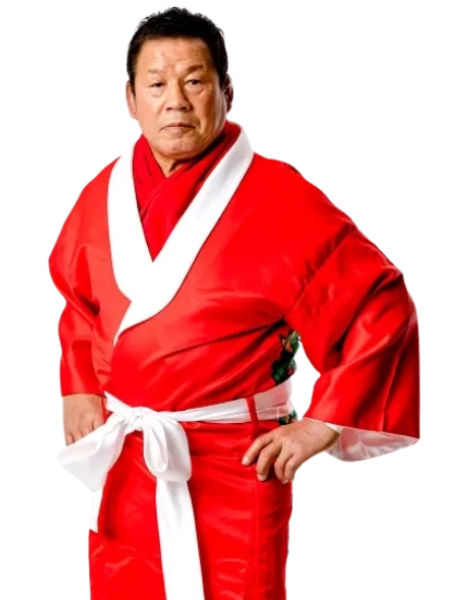
One of his first defining career moments came in December 1987, when he defeated Antonio Inoki, a result that shocked the audience and sparked a fan riot. New Japan treated it as the start of something bigger than a short tour, and it made clear that Vader had arrived as a monster the company planned to build around.
Even after the Big Van Vader persona took hold in Japan, he still took short tours in Europe. From 1989 to 1991, he toured the CWA again under the Bull Power name while New Japan remained his main platform. Wrestling schedules of that era allowed him to split time between markets, and he used it to expand his reputation.
By 1989, he stood at the top of New Japan’s heavyweight division. That spring, he won a major tournament final against Shinya Hashimoto at the Tokyo Dome and became IWGP Heavyweight Champion.
He carried that aura to Mexico in the same period, where in late 1989, he defeated El Canek to win the UWA World Heavyweight Championship as Big Van Vader. He also appeared for Consejo Mundial de Lucha Libre (CMLL) during that same trip. Promoters could drop him straight into main events because the look and the first minutes of his offense told the story.
Around that time, he gained a reputation for frightening realism in the ring. In February 1990, during a violent match with Stan Hansen, a blow dislodged Vader’s eye from its socket. He pushed it back in and kept fighting as the swelling set in. It became one of the moments fans and wrestlers still bring up when they talk about how tough he was.
In 1990, World Championship Wrestling (WCW) signed him and brought him back to the United States. His early WCW run was intermittent, including a quick statement win over Tom Zenk at The Great American Bash on July 7, 1990, but the real breakthrough came when WCW committed to him as a centerpiece in 1992. Harley Race became his manager and framed him as a champion destroyer rather than a traveling attraction.
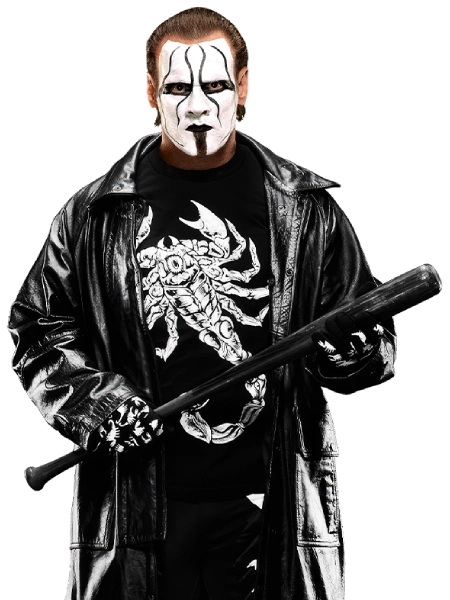
Vader’s feud with Sting defined that phase. After an earlier title shot ended in a disqualification, he defeated Sting for the WCW World Heavyweight Championship at The Great American Bash on July 12, 1992, giving WCW a world champion who looked like a natural disaster come to life.
The title scene changed quickly. With Sting written out injured, WCW substituted Ron Simmons, who defeated Vader on August 2, 1992, to become the new champion. The loss cooled his first reign but left him firmly at the center of WCW’s main events.
He won the championship back from Simmons in December 1992, setting off another two-year stretch where nearly every major WCW storyline ran through him. He fought Sting in multiple rematches, headlined with Ric Flair in a career-versus-title match at Starrcade 1993, and became the promotion’s standard for physical main events.
No feud showed his brutality more clearly than the 1993 series with Mick Foley as Cactus Jack. Their matches pushed violence to new levels on WCW television. During an April 1993 episode of Saturday Night, Harley Race pulled up the protective mats at ringside, and Vader powerbombed Foley onto the exposed concrete.
Foley suffered a legitimate concussion and temporary nerve damage, and WCW used the injury to write him off television for several months. When he returned, the story built toward a Texas Death Match at Halloween Havoc on October 24, 1993, a weapon-filled main event that Vader won after Race’s interference. The series became one of WCW’s clearest examples of how dangerous Vader could feel.
That intensity stayed with him throughout his best matches. He landed heavy body shots, used the powerbomb, and finished with the Vader Bomb. He could also hit a dropkick or moonsault, showing that his size didn’t hold him back. These moves worked because they fit into matches that kept up the pressure.
While dominating WCW, he also kept working in Japan through the Union of Wrestling Forces International. Between 1993 and 1995, wrestling as Super Vader, he won UWFi’s top championship and adapted his style to the promotion’s more realistic, combat-sport tone.
He could play a monster on American television, then step into a shoot-style ring and still look convincing. By late 1995, WCW had steered him toward a program with Hulk Hogan, but disputes led to his departure.
In 1996, he debuted in the World Wrestling Federation (WWF) and was first managed by Jim Cornette. The WWF promoted him as a new destroyer for the company’s evolving main event picture.
He quickly moved into a title feud with Shawn Michaels, and their match headlined SummerSlam on August 18, 1996. Although Vader lost, he stayed a major threat on TV, facing The Undertaker and Kane through 1997 until his run ended in 1998.
The fit wasn’t always as clean as it looked on paper since the WWF style at the time leaned more on pacing, character beats, and television rhythm. Vader could do that work, but his best matches came when opponents and producers let him keep the pressure high.
Japan became his main stage again at the end of the decade. In All Japan Pro Wrestling (AJPW) from 1998 through 2000, he joined a roster built around long, punishing heavyweight matches and on March 6, 1999, defeated Akira Taue to win the Triple Crown Heavyweight Championship. Few foreign wrestlers reached that level there, and his matches against Mitsuharu Misawa fit the promotion’s main event style.
In 2000, Misawa left All Japan and started a new promotion called Pro Wrestling NOAH, bringing many of the same wrestlers and the same heavyweight focus with him. Vader joined soon after and spent that early NOAH period in the tag division, teaming with 2 Cold Scorpio as the company launched its new titles.
On October 19, 2001, they won the tournament final to become the first GHC Tag Team Champions, then dropped the belts to Misawa and Yoshinari Ogawa a month later.
In the years that followed, Vader made select appearances around his name and history. He appeared for NWA Total Nonstop Action (TNA) in early 2003 alongside Dusty Rhodes, returned to Impact Wrestling in 2015 for a brief match with Bram that ended by disqualification, and wrestled Will Ospreay in 2016 for Revolution Pro Wrestling (RevPro) in London.
Vader made violence look efficient, as if the ring narrowed to the few inches between his shoulder and an opponent’s ribs. He moved quickly for his size, but he never moved just to move. He’d step in to take space, lean his weight into every tie-up, and turn basic holds into a struggle for leverage.
When he locked a head and arm, he pulled it tight like he wanted the other man to carry his full weight, then he drove them into the ropes or the corner to force a break on his terms.
His strikes came heavy and short. He threw clubbing forearms that landed with the flat of the arm, not a flourish. He snapped off back elbows in close quarters. He used a blunt boot to the chest that looked less like a kick and more like a shove that happened to have a foot at the end of it.
Most of his signature offense started with the same idea. He pushed a man backward until there was nowhere left to go. In the corner, he threw the body avalanche, a full sprint from a few steps out that ended with his whole torso crushing into the opponent’s chest.
He followed it with another rush, then another, each one faster than the last. Sometimes he came out of the corner and dropped the falling splash, driving it down across the ribs and lungs so the opponent reacted as if the air had left the building.
He also worked in the powerbomb as a signature move rather than just a transition. He would lift his opponent high into the air, holding them there long enough to display his dominance, then slam them down with a forceful impact that resonated through the ring.
The Vaderbomb gave him his signature finish because it combined intimidation with timing. He would climb to the second rope, turn his back to the ring, then drop into a seated splash that drove his weight across an opponent’s chest and midsection.
The roar and the way he always moved forward made all his moves fit together. Vader didn’t ask the crowd to admire his skills. He made them feel the speed, force, and hits, then finished the match before anyone could doubt it.
Leon White died on June 18, 2018, after years of heart and respiratory problems. WWE inducted Vader into its Hall of Fame in 2022, a final acknowledgment that matched the reach of his career. He left a lasting legacy in every major promotion he worked for, including AWA, WCW, NJPW, AJPW, NOAH, and WWF/WWE.


Share Your Thoughts on This Wrestler
You must be logged in to post a comment.