Rob Van Dam, known for most of his career as RVD, built his reputation as a calm, almost casual presence who wrestled at a pace that looked nothing like his expression. He came out of Battle Creek, Michigan, and paired a martial arts influenced striking style with a spring loaded high-flying attack that made him a fixture in the late 1990s boom and a rare talent who later held world titles across ECW, WWE, and TNA.
RVD (Robert Szatkowski) began training under The Sheik, the Detroit area brawler whose school produced wrestlers who could withstand punishment and keep moving. He made his professional wrestling debut in 1990 and spent his early years working in American independent promotions, including the United States Wrestling Association (USWA) and South Atlantic Pro Wrestling (SAPW). He also spent long stretches in Japan with All Japan Pro Wrestling (AJPW) with repeated tours from 1993 through 1997.
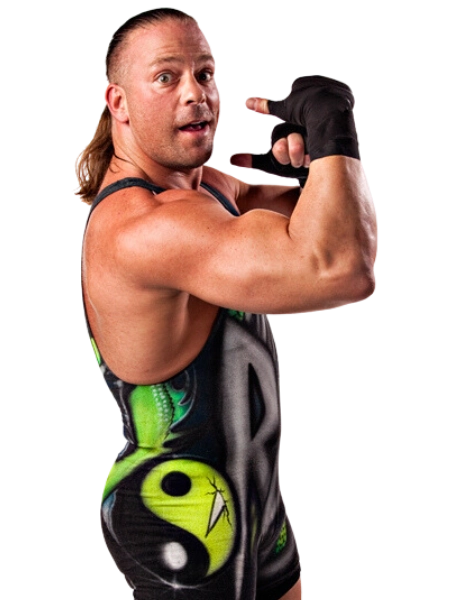
On those tours, he worked against the company’s deep roster in tags and singles, and he began wearing airbrushed singlets as his ring gear after advice from Giant Baba about how to separate himself from other wrestlers. The look became part of the act, with bright custom gear that made him easy to spot even when his matches grew crowded or chaotic.
By the time he returned to the United States, the pieces of the RVD persona had already clicked into place. He had the striking base from his training and the timing and structure that came from Japan. In 1996, Extreme Championship Wrestling (ECW) became the first national stage that let him combine all of it without sanding down the edges.
He was framed as a laid-back fighter who could suddenly turn violent once the bell rang. Bill Alfonso, his loud manager known for whistling and moving around, contrasted with RVD’s calm demeanor. This pairing helped RVD feel more in control, allowing him to command attention without raising his voice.
While with ECW, he moved between singles and tag stories without changing his style. He took on Sabu as both a rival and later a partner, and he built a long running series of matches with Jerry Lynn that let him show a different side of his athleticism through timing, counters, and escalating risk.
His defining ECW run started on April 4, 1998, when he defeated Bam Bam Bigelow to win the ECW World Television Championship. He held the title for 700 days before he vacated it due to injury in 2000. Along the way, he and Sabu also held the ECW World Tag Team Championship.
When ECW folded in 2001, Van Dam moved into the World Wrestling Federation (WWF) during The Invasion storyline and initially worked as one of the ECW-aligned names. He spent the second half of that year working prominent matches on Raw and pay-per-views as the angle played out, then shifted into a steady singles run on Raw built around the Intercontinental Championship.
At WrestleMania X8 in Toronto on March 17, 2002, he beat William Regal to win the Intercontinental title, which still carried the WWF branding at the time. He would lose the belt to Eddie Guerrero at Backlash on April 21, then won it back on Raw on May 27, after WWE’s corporate name change from WWF to WWE happened on May 6th.
On July 22, 2002, he beat Jeff Hardy in a ladder match that unified the European Championship into the Intercontinental Championship, which ended the European title’s run in the WWE.
Van Dam’s reign ended on July 29 when Chris Benoit took the title, but he stayed in the mix through the rest of the summer. At SummerSlam on August 25, 2002, he beat Benoit to reclaim the title, then on Raw the following night, beat the Hardcore Champion, Tommy Dreamer, in another title unification match, making him the final WWE Hardcore Champion on August 26, 2002.
By the mid-2000s, WWE marketed him as “Mr. Pay Per View” and the company treated him as a star who could slide between divisions. At WrestleMania 22 in 2006, he won the Money in the Bank ladder match, guaranteeing him a world title match that he could activate at any point within a year. Instead of waiting for an ambush, he announced his cash in ahead of time and chose an ECW themed event as the setting.
On June 11, 2006 at ECW One Night Stand, Van Dam cashed in and defeated John Cena to win the WWE Championship. Two nights later, on the debut episode of the revived ECW brand, Paul Heyman presented him with the reactivated ECW World Heavyweight Championship, and Van Dam carried both world titles at once for a brief stretch.
The run ended abruptly after a July 2, 2006 traffic stop in Hanging Rock, Ohio. Police stopped Van Dam for speeding, said they smelled marijuana, and searched the vehicle. Van Dam was found with 18 grams of marijuana and five Vicodin pills. He would later plead guilty to speeding and third-degree possession of marijuana, but the Vicodin charge was dropped after he showed a valid prescription.
Even so, the damage was done. Before his court appearance, WWE announced they would be suspending him for 30 days, and the company took both belts off him that week. He dropped the WWE Championship to Edge on Raw, then lost the ECW Championship to the Big Show the next night on ECW.
He remained with WWE into 2007, then left and returned to the independent circuit, working a schedule that let him pick opponents and promotions while keeping his ring style largely intact.
He then signed with Total Nonstop Action Wrestling (TNA) in 2010 and was immediately positioned as a headliner. Within weeks, he reached the top of the card, and on April 19, 2010, he defeated AJ Styles to win the TNA World Heavyweight Championship. TNA used him in the EV 2.0 group with other ECW alumni, blending nostalgia with new rivalries, and he stayed under contract through 2013, including a later run with the X Division Championship.
During this time, he also took selected international dates, including an appearance for Lucha Libre AAA Worldwide in 2011. His name still carried weight as evidenced by his challenge to Dr. Wagner Jr. for the newly created AAA Latin American Championship at Triplemanía XIX, where he lost in the main event.
WWE brought him back in 2013 for a second run built around special attractions and pay-per-view matches. He returned at Money in the Bank in Philadelphia and worked through programs that put him against newer stars and established champions, including a summer feud with Chris Jericho and a series with Alberto Del Rio. That run ended in 2014, and he went back to a mix of independent bookings and shorter promotion deals.
In 2019, he returned to TNA and leaned into the ECW connection again by teaming with Sabu against the Lucha Brothers at United We Stand, one of the most visible matches of that WrestleMania weekend for the company.
His Impact run included an on-screen shift into a heel role later that year and continued into 2020 before he moved on.
Even after decades in the business, Van Dam continued to take occasional high-profile international and television dates. In 2022, he worked CyberFight Festival as part of the Pro Wrestling NOAH side of the supershow, teaming with HAYATA and Yoshinari Ogawa in a six-man tag.
In 2023, he appeared in AEW, debuting on Dynamite and wrestling Jack Perry for the FTW Championship on August 9 under FTW rules. WWE also continued to use him for nostalgia and ceremonial appearances, including a Raw Reunion in 2019 and his induction into the WWE Hall of Fame in 2021.
Across all those stops, Rob Van Dam presented himself as unbothered, and even playful at times. He wrestled with a rhythm that felt loose until the moment he snapped into a strike or launched into the air.
He built his offense around stiff kicks and quick spinning strikes, then linked them to rope running and slingshot attacks that let him turn a missed shot or a scramble on the mat into instant offense. He worked from unusual positions on the top rope and along the apron, and made the ring feel wider by using the corners and the barricade as part of his movement.
Those sequences usually funneled into the same recognizable finish. He hit Rolling Thunder, floated into a split-legged moonsault, and closed with the Five-Star Frog Splash, a jump he stretched out with long hang time and a clean drop.
When weapons came into play, he folded a chair into the same timing with the Van Daminator, kicking it into an opponent’s face, and the Van Terminator, the longer range version, where he launched himself across the ring and drove the chair into someone pinned in the corner.
The flexibility of his move set remained central to the act, since it fueled his sudden pinning combinations and quick escapes, keeping his offense moving in a continuous line rather than stopping and restarting between big moments.
Promotions changed around him, styles rose and fell, and his schedule shifted from full-time runs to selective appearances, but the version of RVD that fans first saw in the late 1990s never really disappeared.
In recent years, he has worked mainly on special dates while remaining under a WWE Legends deal, including a surprise entry in MLW’s Battle Riot match in April 2025. After that MLW match, he said he had fractured both heels, putting him on the shelf with no clear timeline for his return.
Away from the ring, he stays visible through his own media and booking calendar, treating wrestling as something he can step into when the right match or appearance makes sense.



Share Your Thoughts on This Wrestler
You must be logged in to post a comment.