Career Summary
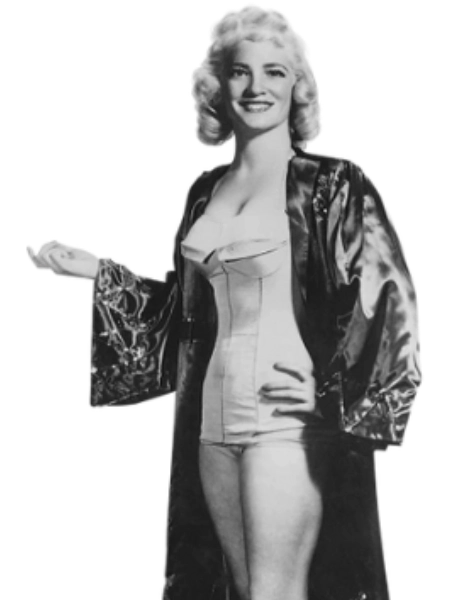
Judy Grable was one of the most athletic and eye-catching women’s wrestlers of the 1950s and 1960s. Known as “The Barefoot Contessa”, she wrestled barefoot, flew around the ring with high dropkicks, and became a regular challenger to The Fabulous Moolah in the National Wrestling Alliance (NWA) system.
Long after she stopped wrestling, she was remembered as one of the early high flyers in women’s wrestling and was later honored by several major wrestling halls of fame.
She was born Nellya Baughman on August 21, 1935, and was the youngest of six children in a family with four brothers and one sister. Growing up, she liked fishing, hunting, and school sports, and even took part in amateur wrestling at Grand Junction High School.
Her family later moved to Sarasota, Florida, where she became fascinated by the traveling circus that came through town. She spent about six months working as an acrobat for Ringling Brothers, but chose to leave after falling from a high wire and decided that wrestling appealed to her more because, in her words, “in wrestling you have something to hold on to.”
Looking for a way into the ring, she went to train in Columbia, South Carolina, with Buddy Lee and his wife, Lillian Ellison, better known as The Fabulous Moolah. They ran a school and booking office that supplied women wrestlers to promoters across the United States. After training there, she made her debut in 1953. At first, she wrestled under the name Peaches Grable, then soon settled on Judy Grable as her main ring name.
Once she was on the road, Grable worked in many NWA-affiliated territories. She appeared in Georgia Championship Wrestling (GCW), Jim Crockett Promotions (JCP) in the Carolinas, and other groups tied to the Alliance, as well as in promotions like Championship Wrestling from Florida (CWF) and the American Wrestling Association (AWA). She was usually presented as a babyface and became a regular opponent for Moolah on cards around the country.
In September 1956, a battle royal was held to crown a new women’s world champion recognized by the NWA. Grable reached the final stages of the match but was ultimately beaten by Moolah, who then began the long run that WWE later treated as the starting point of its women’s championship history.
In the ring, Judy Grable wrestled with a style that was fast and acrobatic for its time. She wrestled barefoot for most of her career, and writers of the day called her “an acrobatic blonde with educated flying feet”.
Her signature moves included cartwheels into attacks, running and standing dropkicks, flying kicks from different angles, and a rolling flip that some described as the Kangaroo Flip, which she treated as a finishing move. She would also use the usual holds and rough tactics of the era, including hair pulling and punches, and she liked to start matches by landing the first strike.
Grable also collected a number of regional titles during her peak years. In Georgia Championship Wrestling, she became the first NWA Southern Women’s Champion in 1958 and later regained that belt for a second reign.
In other territories, she held women’s championships recognized by groups such as American Women’s Wrestling and California-based promotions. These titles, along with her steady bookings against Moolah, helped confirm her place as one of the leading women wrestlers of the 1950s and early 1960s, even though she never had a long run with the world championship.
As the 1960s went on, injuries and the strain of constant travel began to catch up with her. She had broken both ankles and dealt with ongoing back problems, and by the middle of the decade, she started to cut back on her schedule. She was reported as retiring in 1966, but she continued to wrestle on a part-time basis.
From the late 1960s into the early 1970s, she worked a lighter schedule across several territories. She took dates for Georgia Championship Wrestling, Stampede Wrestling in Canada, and promotions based out of Vancouver. She would also return to the WWWF from time to time. In 1974, she had a brief comeback run in Dean Silverstone’s Superstar Championship Wrestling (SCW), where she made a point of wrestling in boots rather than going barefoot.
In 1979, she made a short tour of Mexico for the Universal Wrestling Association (UWA), working tag team matches alongside Vicki Williams, and her final recorded bout took place on March 13, 1980, in Kansas City, where she defeated Judy Martin for Central States Wrestling. After that match, she left the ring for good.
After leaving wrestling behind as a full-time job, Grable focused on family life and a new career. She returned to school, then worked for many years as a certified nursing assistant in a home for military veterans.
People who knew her from that time remembered her as someone who cared for elderly and sick residents with patience and energy. One of her daughters later followed her into the ring under the name Debbie Grable, which added a second generation to the family’s connection to wrestling.
Judy Grable died in May 2008 at the age of seventy two after dealing with diabetes, strokes, and early stage Alzheimer’s disease. Different sources list slightly different exact dates for her passing, but they agree on the month and year.
In the years that followed, her contributions were recognized by several honors. The Cauliflower Alley Club listed her among its honorees, the Professional Wrestling Hall of Fame inducted her in 2011 in its women’s category, and WWE added her to its Hall of Fame in 2017 as part of the Legacy wing.
At a time when women’s wrestling in North America was tightly controlled and often pushed to the margins of cards, Grable made a name for herself through movement and risk taking that felt unusual for the era. Her barefoot style, flying dropkicks, and lively personality made her one of the key early high flyers in women’s wrestling.
Matches
No matches recorded for this wrestler yet.




Share Your Thoughts on This Wrestler
You must be logged in to post a comment.